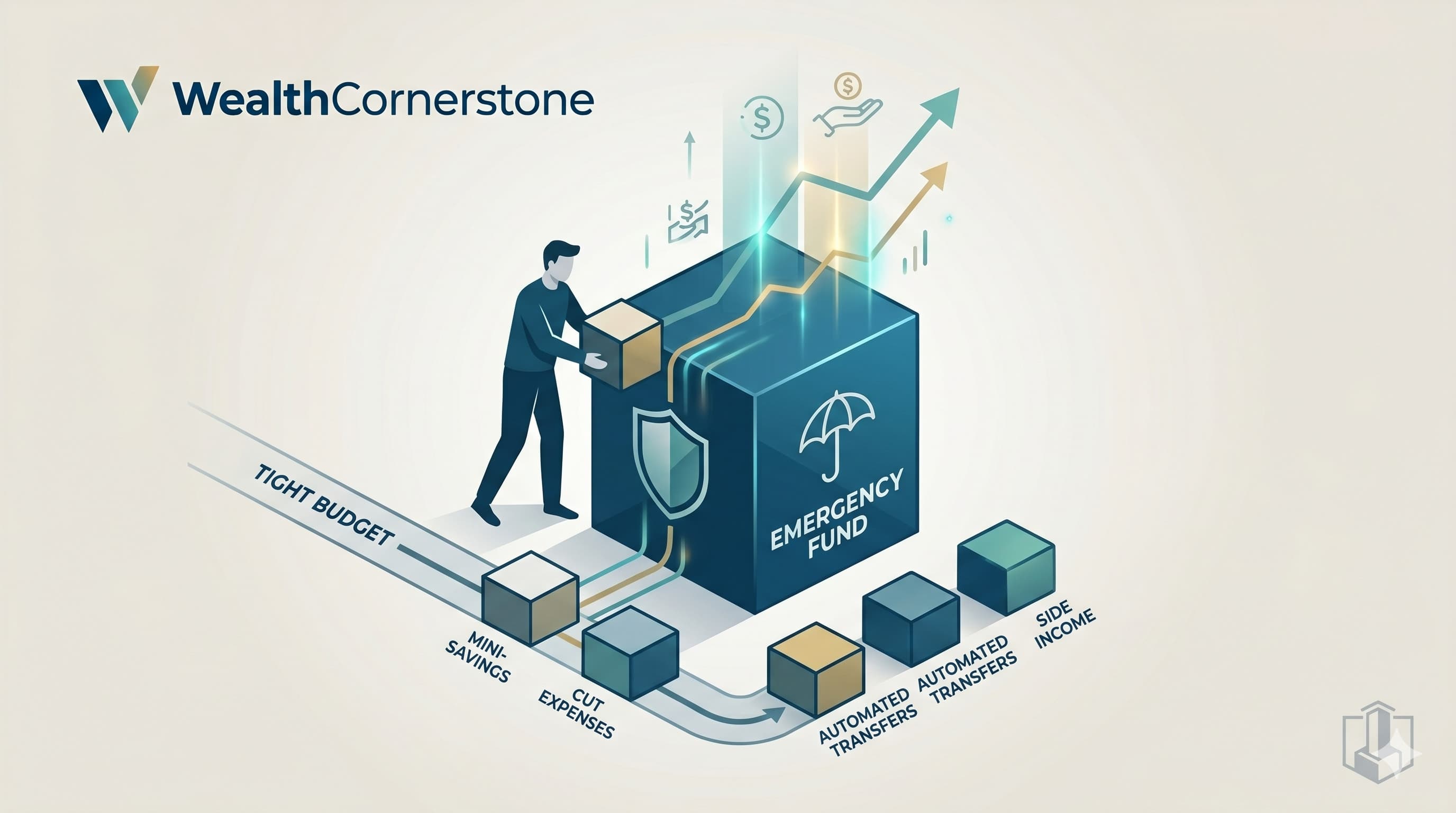
An emergency fund is a stash of money you keep in a safe place to pay for unexpected problems, like a car breakdown or losing your job. It is your financial "break glass in case of emergency" box that ensures a temporary setback doesn't turn into a long-term debt disaster. By using an emergency fund calculator, you can determine exactly how much you need to set aside to keep your household running smoothly when life throws a curveball. This article is for educational purposes only and does not constitute personalized financial advice. Consult a qualified financial advisor before making significant financial decisions.
Having a dedicated cash reserve is the cornerstone of any healthy financial plan. Without it, you are essentially living on a tightrope without a net. Whether it is a sudden medical bill, an urgent roof repair, or an unexpected layoff, having liquid cash allows you to handle the situation with logic rather than panic. For most people, the question isn't whether they need one, but rather how much is enough to sleep soundly at night without over-funding a low-interest account.
The Core Framework: The 3-to-6 Month Rule
The most widely accepted mental model for savings is the 3-to-6 month rule. This framework suggests that you should calculate your essential monthly living expenses and multiply that number by a factor of three or six. The goal is to replace your income's purchasing power for a set duration if your primary source of revenue disappears. This rule is not about replacing your entire paycheck, but rather covering the "must-pay" bills that keep your life functioning.
To apply this rule, you must first distinguish between "essential" and "discretionary" spending. Essential expenses include your mortgage or rent, utilities, groceries, insurance premiums, transportation costs, and minimum debt payments. Discretionary spending—like dining out, streaming subscriptions, and hobby costs—is typically excluded from this calculation because you would theoretically cut those costs immediately during a crisis.
Consider the example of Mark and Lisa, a married couple living in a suburban area. Their combined take-home pay is $8,000 per month. However, after reviewing their bank statements, they realize their "survival" budget—the bare minimum needed to keep the house running—is only $4,500.
- 3-Month Target: $4,500 x 3 = $13,500
- 6-Month Target: $4,500 x 6 = $27,000
Because Mark and Lisa both have stable government jobs with high job security, they might opt for the lower end of the spectrum ($13,500). If one of them worked in a volatile industry like tech or construction, they would likely lean toward the $27,000 mark. This framework provides a clear, mathematical target that removes the guesswork from your savings goals.
Customizing Your Target: Assessing Your Risk Profile
While the 3-to-6 month rule is a great starting point, your specific "number" depends heavily on your unique risk profile. A single person renting an apartment with no dependents has a vastly different risk level than a family of five with a large mortgage and a single income. To find your ideal how much emergency fund amount, you must look at the variables that make your life more or less expensive during a crisis.
When assessing your risk, consider the following factors:
- Job Stability: Are you tenured in a stable field, or are you a freelancer with "lumpy" income?
- Number of Income Streams: If one person loses a job in a dual-income household, the impact is less severe than for a single-income household.
- Dependents: Children, elderly parents, or pets increase the likelihood of unexpected medical or care-related costs.
- Health Status: High-deductible health plans require a larger cash buffer to cover out-of-pocket maximums.
- Homeownership: Renters can call a landlord for a broken water heater; homeowners must pay for it themselves.
Take the case of Elena, a freelance graphic designer. Elena’s monthly expenses are $3,500. Because her income fluctuates and she doesn't have access to employer-sponsored unemployment insurance, a standard 3-month fund of $10,500 feels risky to her. If she loses her biggest client, it might take her four or five months to replace that revenue. For Elena, an 8-month fund of $28,000 is more appropriate. This larger cushion accounts for the inherent volatility of her career path.
Benchmarks and Tiers: Finding Your Personal Number
Not every emergency requires a six-month "life reset" fund. Many financial experts recommend a tiered approach to savings. This involves building a "starter" fund of $1,000 to $2,000 to handle minor inconveniences, then slowly graduating to a full-sized fund. This approach prevents you from feeling overwhelmed by a massive five-figure goal right at the start.
The table below compares three common scenarios to help you identify where you might fall on the spectrum of months of expenses saved.
| Risk Level | Lifestyle Profile | Recommended Fund Size | Example Calculation (at $4k/mo) |
|---|---|---|---|
| Low | Dual income, stable jobs, renting, no kids | 3 Months | $12,000 |
| Moderate | Dual income, 1 stable/1 variable, homeowners, kids | 6 Months | $24,000 |
| High | Single income, freelancer/commission, high-deductible health | 9-12 Months | $36,000 - $48,000 |
To begin your journey, follow these prioritized steps:
- Calculate your "Survival Number" (the sum of all non-negotiable monthly bills).
- Save an initial $1,000 "Starter Fund" to cover immediate repairs (tires, appliances).
- Pay off high-interest debt (anything above 8-10% APR) to free up cash flow.
- Build toward your 3-month "Stability Fund."
- Extend to a 6-month "Security Fund" if your risk profile warrants it.
For instance, David and Sarah are a young couple with two children. They own a home built in the 1970s, which is prone to needing repairs. Their survival budget is $5,000. They decide on a 6-month benchmark of $30,000. They started with $1,000, and it took them 18 months of disciplined saving to reach their full goal. Now, when their HVAC system failed last summer costing $6,000, they didn't have to use a credit card; they simply dipped into their "Security Fund" and replenished it over the following months.
Use the calculator below to find your number in seconds.