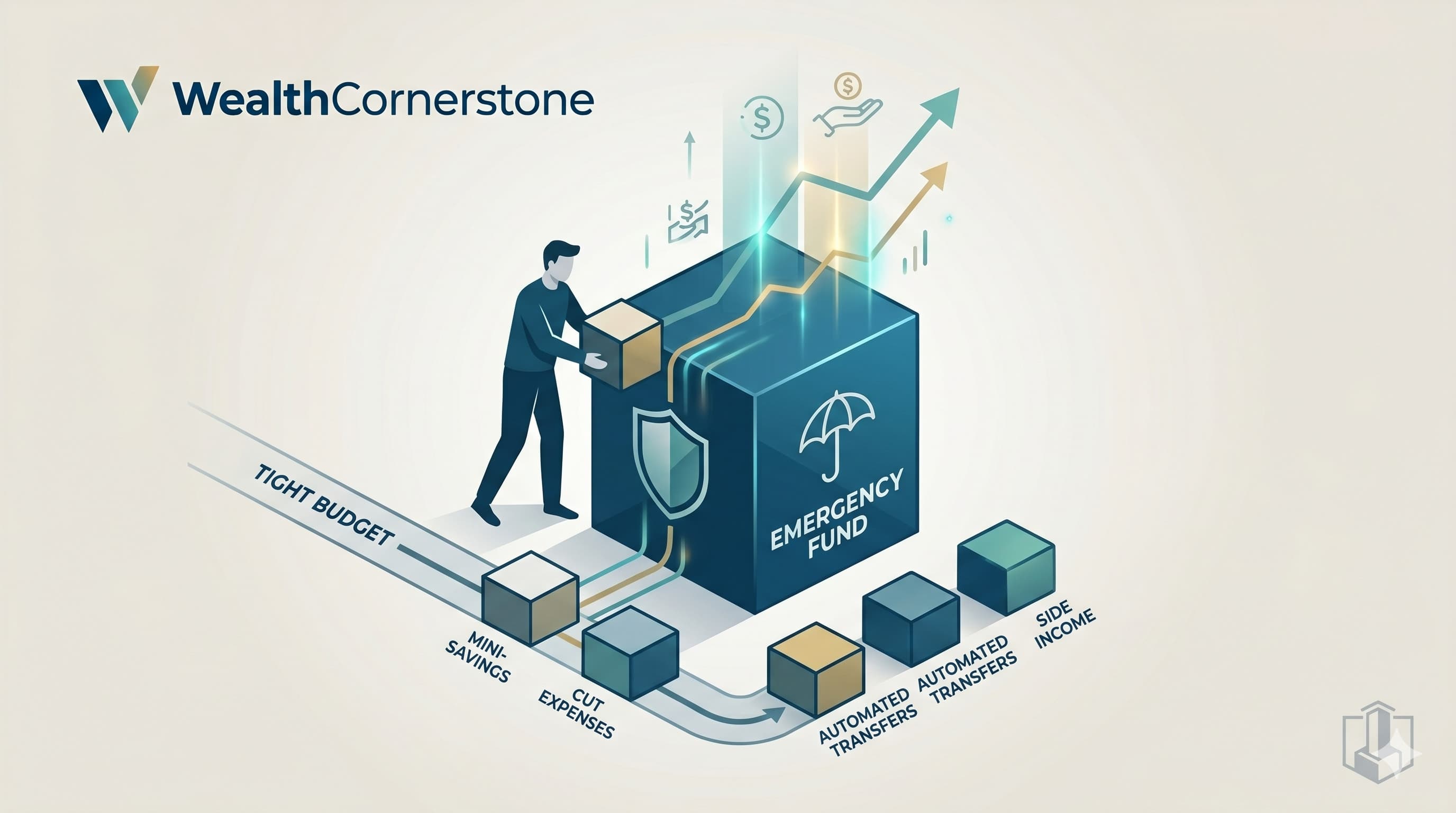
How to Save Money on a Low Income
Learning how to save on low income is a fundamental skill that provides a foundation for long-term financial security. Saving money simply means keeping a portion of the money you receive instead of spending it immediately. While it may feel impossible to set aside funds when your monthly bills consume most of your paycheck, the process is less about the total amount of money you earn and more about the systems you put in place to manage it. This article is for educational purposes only and does not constitute personalized financial advice. Consult a qualified financial advisor before making significant financial decisions.
For many households, the struggle to find "extra" money is a daily reality. However, financial resilience is built one dollar at a time. Whether you are earning minimum wage or dealing with a temporary dip in income, the strategies for wealth building remain the same: reduce unnecessary outflows, optimize your fixed costs, and automate your contributions to a safety net. By mastering a few specific money saving hacks and adopting practical frugal living tips, you can break the cycle of living paycheck to paycheck and begin building a cushion for the future.
The Zero-Based Budgeting Framework
The most effective mental model for saving when margins are tight is Zero-Based Budgeting (ZBB). Unlike traditional budgeting, where you simply track what you spent at the end of the month, ZBB requires you to give every single dollar a "job" before the month begins. The formula is simple: Income minus Expenses equals Zero. This does not mean you have zero dollars in your bank account; rather, it means every cent is assigned to a category—including savings.
When you use this framework, you prioritize your savings as a non-negotiable "expense" rather than a leftover amount. This shift in perspective ensures that your goals are funded first, rather than being at the mercy of impulsive spending later in the month.
Real-World Worked Example: Maria’s Budget
Consider Maria, who works as a retail assistant and earns $2,400 in take-home pay each month. Without a plan, Maria often finds herself with $10 left by the 28th of the month. Using the Zero-Based Budgeting framework, Maria assigns her $2,400 as follows:
- Housing (Rent/Insurance): $1,100
- Utilities & Phone: $180
- Groceries: $350
- Transportation (Gas/Bus): $200
- Debt Repayment (Credit Card): $150
- Savings (Emergency Fund): $120
- Personal/Misc: $300
- Total: $2,400
By assigning that $120 to her savings category on day one, Maria ensures that her savings grow by $1,440 over the course of a year. If she had waited until the end of the month, that $120 likely would have been absorbed by the "Personal/Misc" category or an extra grocery trip.
Steps to Implement Zero-Based Budgeting
- List your total monthly take-home pay (after-tax income).
- List all fixed expenses (rent, utilities, insurance).
- List variable expenses (groceries, gas, entertainment).
- Subtract your expenses from your income.
- If the number is positive, assign the remainder to savings or debt.
- If the number is negative, cut variable expenses until you reach zero.
Building Your Safety Net: Benchmarks for Success
When your income is limited, the standard advice of having six months of expenses saved can feel overwhelming and even discouraging. Instead, it is better to look at savings in tiers. Focusing on small, achievable benchmarks helps maintain motivation and prevents the "all-or-nothing" mentality that causes many to stop saving entirely.
The primary goal for anyone on a low income should be the "Starter Emergency Fund." This is typically $1,000 or one month of essential expenses. This fund acts as a buffer against high-interest debt. If a tire blows out or a medical co-pay arises, you pay for it with cash instead of a credit card that charges 24% APR.
Savings Benchmarks for Low-Income Households
| Tier |
Goal Amount |
Purpose |
| Tier 1: Starter Fund |
$1,000 |
Covers minor repairs and prevents new debt. |
| Tier 2: One-Month Buffer |
1 Month of Expenses |
Provides a safety net for a missed week of work. |
| Tier 3: Full Emergency Fund |
3-6 Months of Expenses |
Protects against job loss or major medical events. |
| Tier 4: Sinking Funds |
Variable |
Covers non-monthly costs like car registration or holidays. |
Use the calculator below to find your number in seconds.
Frugal Living Tips to Optimize Every Dollar
To increase the amount you can save, you must widen the gap between your income and your expenses. On a low income, this often requires aggressive optimization of your largest variable costs. Food and housing are usually the two biggest categories where "leaks" occur. Implementing specific frugal living tips in these areas can yield hundreds of dollars in annual savings.
Strategic Grocery Management
Food costs are often the most flexible part of a budget. By moving away from convenience and toward strategy, you can slash your bill without sacrificing nutrition.
- Unit Pricing: Always look at the "price per ounce" or "price per unit" on the shelf tag. Often, the larger package is cheaper, but sometimes sales make the smaller package a better value.
- Store Brands: Switching from name brands to generic or store brands for staples like flour, sugar, canned beans, and frozen vegetables can save 20-30% on your total bill.
- The "Pantry First" Rule: Before going to the store, shop your own pantry and freezer. Plan your meals around what you already have to avoid buying duplicates.
- Meatless Days: Incorporating protein-rich legumes and grains two or three times a week can significantly lower costs compared to buying beef or poultry for every meal.
Worked Example: The Coffee and Lunch Shift
Consider David, who earns $32,000 a year. He spends $4 on a coffee every morning and $12 on a quick lunch during his break. This totals $16 a day, or roughly $320 a month (assuming 20 workdays). By switching to home-brewed coffee and meal-prepping simple lunches (costing roughly $3 total per day), David saves $13 a day. This results in $260 a month in reclaimed income, which represents nearly 10% of his monthly take-home pay.
Money Saving Hacks to Lower Monthly Fixed Costs
Fixed costs—the bills that stay the same every month—often feel set in stone, but they are frequently negotiable. Reducing these costs provides "passive" savings, as you only have to do the work once to reap the benefits every month thereafter.
Bill Negotiation and Service Audits
Many service providers, particularly in telecommunications and insurance, offer "introductory rates" to new customers. Existing customers often pay a "loyalty tax" in the form of higher rates.
- Phone and Internet: Call your provider and ask for the "retention department." Mention a competitor's lower price and ask if they can match it.
- Insurance Shopping: Every 12 months, get quotes from at least three different auto insurance providers. Switching can often save $200-$500 per year for the same coverage.
- Utility Assistance: Many states offer programs like LIHEAP (Low Income Home Energy Assistance Program) or weatherization assistance that can permanently lower your heating and cooling costs.
Automation: The Ultimate Saving Hack
The biggest hurdle to saving on a low income is the "decision fatigue" of choosing to save every time you get paid. You can bypass this by automating the process. Even if you can only afford $5 per paycheck, setting up an automatic transfer from your checking account to a High-Yield Savings Account (HYSA) ensures the money is moved before you have a chance to spend it. Over time, you will adjust to living on the slightly smaller amount in your checking account, effectively making your savings "invisible."
- Round-Up Apps: Some banking apps round up your purchases to the nearest dollar and invest the change.
- Direct Deposit Split: Ask your employer if you can split your direct deposit so that a small percentage goes directly into a separate savings account.
- Micro-Saving: Use apps that analyze your spending and pull small amounts ($2 to $10) into a separate account when the app determines you won't miss it.
The Credit Card Minimum Trap: A Mistake Simulation
One of the most devastating mistakes people make when trying to save on a low income is the "Minimum Payment Trap." When money is tight, it is tempting to pay only the minimum amount due on credit cards to keep more cash on hand for daily expenses. However, this decision is incredibly expensive in the long run and can trap you in a cycle of poverty for years.
The Scenario: The True Cost of Minimums
Let’s look at Sarah. Sarah has a $3,000 balance on a credit card with a 24% APR. Her minimum payment is $90. She decides to only pay the minimum so she can use the "extra" money for her social life and non-essential shopping.
- Option A (Minimum Only): If Sarah only pays the $90 minimum and never adds another charge, it will take her over 20 years to pay off the balance. During that time, she will pay over $6,000 in interest alone. Her $3,000 debt actually costs her $9,000.
- Option B (Minimum + $50): If Sarah finds a way to pay $140 a month (an extra $50 found through frugal living tips), she will pay off the card in about 2.5 years and pay only about $1,000 in interest.
The Real Dollar Cost of the Mistake
By choosing the "convenience" of the minimum payment, Sarah effectively sets fire to $5,000 over the next two decades. For someone on a low income, $5,000 is a life-changing amount of money—it could be a down payment on a car, a college fund for a child, or a substantial start to a retirement account. This simulation shows that paying off high-interest debt is actually one of the most effective ways to "save" money, as it prevents future interest payments from leaving your pocket.
Next Steps on Your Financial Journey
Building wealth on a low income is a marathon, not a sprint. The most important thing you can do today is to start small and remain consistent. Whether you begin by tracking your expenses for 30 days or by negotiating one monthly bill, every action you take creates momentum.
Your next step is to formalize your plan. Take an hour this weekend to calculate your "Zero-Base" and identify one area where you can cut back. If you want to dive deeper into specific tactics for growing your net worth regardless of your starting point, explore more savings strategies that can help you optimize your financial life. Remember, the goal is progress, not perfection. Every dollar you save today is a building block for the freedom you will enjoy tomorrow.
Frequently Asked Questions
Should I save money or pay off debt first?
This depends entirely on the interest rate of your debt and the state of your emergency fund. Most financial experts recommend saving a "starter" emergency fund of $1,000 before aggressively paying down debt. This prevents you from having to use credit cards again when an unexpected expense arises. Once that $1,000 buffer is in place, you should prioritize paying off any debt with an interest rate higher than 7-8%, such as credit cards or payday loans. Debts with lower interest rates, like many student loans or mortgages, can often be paid on a standard schedule while you simultaneously build your larger 3-6 month emergency fund.
How much should I save if I only earn $30,000 a year?
On a $30,000 annual salary (which is roughly $2,500 per month before taxes), a common goal is to aim for a 5% to 10% savings rate. This would mean setting aside $100 to $200 per month. If your cost of living is high and $100 feels impossible, start with 1% ($25 a month). The key is the habit of saving rather than the initial amount. As you find more frugal living tips that work for your lifestyle or eventually increase your income, you can scale that percentage up. Even $25 a month adds up to $300 a year, which can cover a surprise car battery or a small home repair, keeping you out of debt.
Where is the best place to keep my savings so I don't spend them?
The best place to keep your savings is in a High-Yield Savings Account (HYSA) at a completely different bank than your primary checking account. By keeping the money in a separate institution, you remove the temptation to "transfer" funds instantly when you see something you want to buy. HYSAs currently offer much higher interest rates than traditional big-bank savings accounts—often 10 to 20 times higher—allowing your money to grow faster through compound interest. Additionally, ensure the bank is FDIC-insured so your deposits are protected up to $250,000. Having that physical and digital "distance" between your spending money and your savings is a powerful psychological tool for success.