How to Open a High-Yield Savings Account
A high-yield savings account is a secure bank account that pays you a significantly higher interest rate on your deposits than a standard savings account. Opening a high yield savings account is one of the most effective moves you can make to protect your money from inflation while keeping it accessible for emergencies or short-term goals. While traditional "big box" banks often offer interest rates near zero, these specialized accounts leverage the lower overhead of online-only institutions to pass more profit back to you in the form of interest.
For anyone looking to maximize their wealth, understanding the mechanics of an HYSA is essential. These accounts are generally FDIC-insured up to $250,000 per depositor, making them as safe as any traditional bank. They are designed for your "liquid" cash—money you might need next week or next year—rather than long-term investments like stocks. By shifting your idle cash into an account with the best savings rates, you ensure that every dollar you work for is also working for you.
This article is for educational purposes only and does not constitute personalized financial advice. Consult a qualified financial advisor before making significant financial decisions.
The Core Framework: The 3-6 Month Emergency Fund Rule
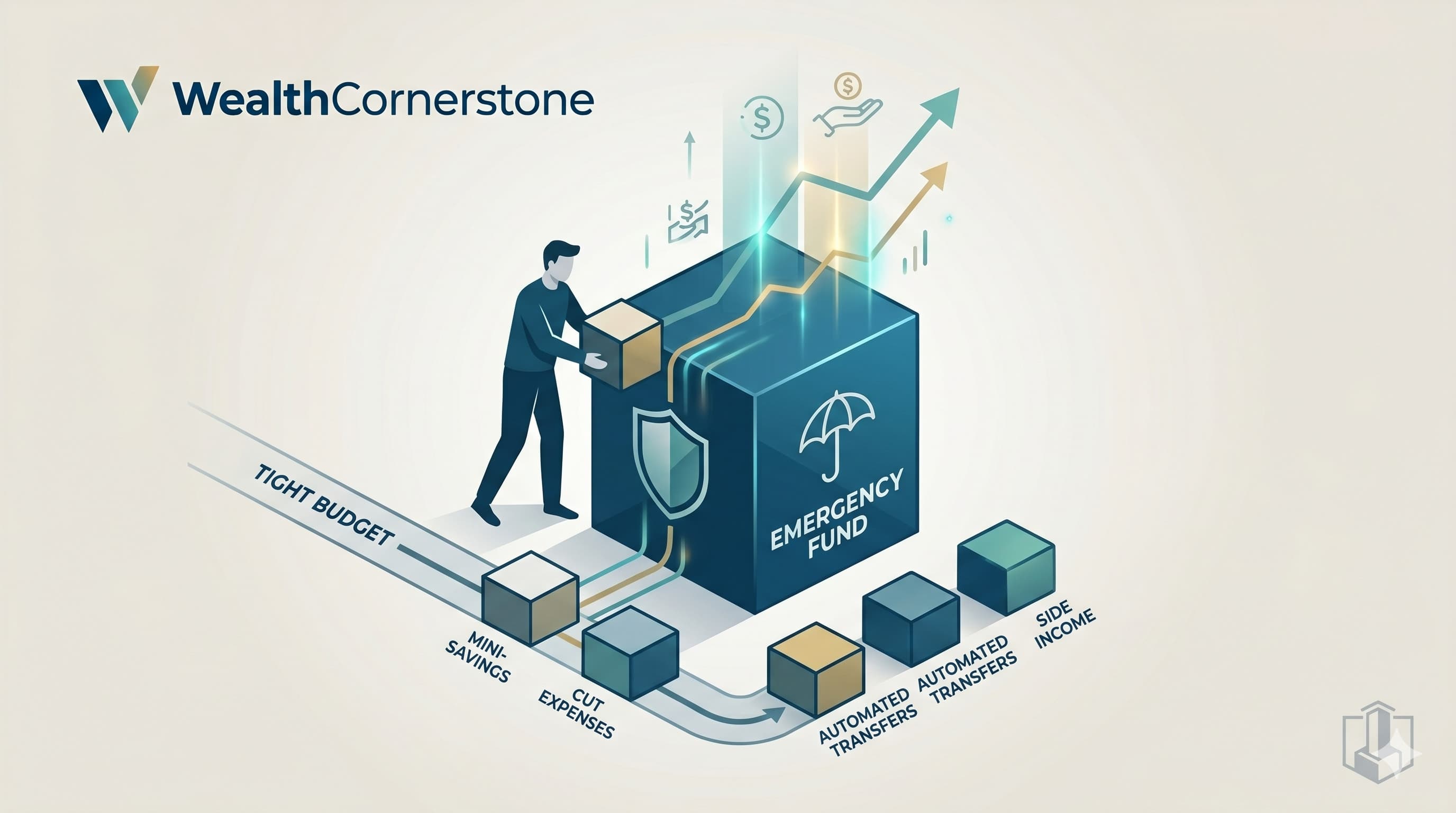
When you open a high yield savings account, the first question is often: "How much money should I put in it?" Financial experts generally govern this decision using the 3-6 Month Emergency Fund Rule. This framework suggests that every household should maintain a liquid cash reserve equal to three to six months of essential living expenses. This fund acts as a financial shock absorber, preventing you from going into high-interest debt when life’s unexpected costs—like a car repair or medical bill—inevitably arrive.
To apply this rule, you must first calculate your "survival number." This is not your total income, but the absolute minimum amount you need to pay for housing, food, utilities, insurance, and transportation. Once you have this monthly figure, you multiply it by your desired "safety factor" (3 for stable single earners, 6 for families or those with irregular income).
Real-World Worked Example: Marcus and the Security Shield
Marcus is a 29-year-old graphic designer earning $5,500 per month after taxes. He lives in a city with a moderate cost of living. To find his high-yield savings target, Marcus calculates his monthly essential expenses:
- Rent and Utilities: $1,800
- Groceries and Household Essentials: $500
- Car Payment and Insurance: $450
- Health Insurance and Out-of-Pocket Meds: $250
- Total Monthly Essential Expenses: $3,000
Using the 3-6 month framework, Marcus decides that a 4-month buffer is appropriate for his situation as a freelancer. His target for his HYSA is $12,000. By keeping this $12,000 in a high yield savings account earning 4.50% APY rather than a standard account earning 0.01%, Marcus earns roughly $540 in interest per year just for being prepared. If he kept that same money in his old checking account, he would earn a mere $1.20 annually.
Benchmarking Your Returns: HYSA vs. Traditional Savings
It is difficult to appreciate the value of an HYSA without looking at the specific numbers that separate modern online banks from traditional brick-and-mortar institutions. Most large national banks rely on brand recognition and physical branches to attract customers, which allows them to keep interest rates artificially low. Online banks, conversely, compete primarily on the best savings rates they can offer to consumers nationwide.
The table below illustrates the dramatic difference in earnings potential between account types based on a $20,000 deposit over a single year.
| Account Type |
Average APY (Annual Percentage Yield) |
Annual Interest Earned |
5-Year Interest (Compounded) |
| Traditional Big Bank Savings |
0.01% |
$2.00 |
$10.01 |
| National Average Savings |
0.45% |
$90.00 |
$458.13 |
| Top-Tier HYSA |
4.50% |
$900.00 |
$4,923.64 |
| High-Performance HYSA |
5.00% |
$1,000.00 |
$5,525.63 |
As shown, the "opportunity cost" of staying with a low-yield bank is not just a few dollars; it is hundreds or even thousands of dollars over time. This interest is "passive," meaning it requires zero labor on your part once the account is open. To determine how much you should be setting aside for your own financial peace of mind, use the calculator below to find your number in seconds.
How to Vet a High-Yield Savings Account Provider
Not all high-yield savings accounts are created equal. While the interest rate is the headline feature, savvy savers look at the total "cost of ownership" and ease of use. When you are scouting for the best savings rates, you must balance the yield with the reliability of the institution.
Consider these factors when comparing providers:
- FDIC or NCUA Insurance: This is non-negotiable. Ensure the bank is a member of the Federal Deposit Insurance Corporation (or the National Credit Union Administration for credit unions). This protects your deposits up to $250,000 if the bank fails.
- Compounding Frequency: Look for accounts that compound interest daily. This means your interest begins earning its own interest every 24 hours, rather than once a month.
- Fees and Minimums: Many of the best HYSAs have $0 monthly maintenance fees and $0 minimum balance requirements. Avoid any account that "eats" your interest with monthly service charges.
- Transfer Speed: Since your HYSA is likely at a different bank than your primary checking, check how long it takes to move money. Most modern banks offer 1-3 business day transfers via ACH.
- User Interface: A high yield savings account you can't access easily on your phone is a liability. Check app store ratings for the bank’s mobile platform.
Real-World Scenario: Sarah’s Selection Process
Sarah, 34, has $15,000 to move into a new account. She finds two options: Bank A offers 5.10% APY but requires a $25,000 minimum balance to avoid a $20 monthly fee. Bank B offers 4.60% APY with no minimums and no fees.
If Sarah chooses Bank A, she will pay $240 in fees per year because her balance is below the minimum. Her total interest earned would be $765, but after fees, she keeps only $525. If she chooses Bank B, she earns $690 and keeps all of it. Sarah chooses Bank B, realizing that a slightly lower rate with better terms often results in more money in her pocket.
A Five-Step Guide to Opening Your Account
Opening an HYSA is surprisingly fast. In the digital age, the process usually takes less than ten minutes from start to finish. Follow these steps to ensure a smooth setup:
- Gather Your Documentation: You will need your Social Security Number (SSN), a valid government-issued ID (like a driver's license), and your current bank's routing and account numbers to fund the new account.
- Submit the Online Application: Visit the official website of your chosen bank. Look for the "Open Account" button. You will be asked for basic information, including your legal name, physical address, and employment status.
- Verify Your Identity: Federal "Know Your Customer" (KYC) laws require banks to verify who you are. Some banks do this instantly; others may ask you to upload a photo of your ID.
- Connect Your Funding Source: You will link your existing checking account to the new HYSA. Most banks use a third-party service like Plaid for instant verification, or they will send two small "micro-deposits" (usually a few cents) to your checking account that you must verify a day later.
- Initiate Your First Transfer: Once linked, move your initial deposit. Remember that while the interest starts accruing immediately, it may take a few days for the funds to fully "clear" and be available for withdrawal.
Real-World Scenario: Jasmine’s Quick Start
Jasmine decided to open an account with an online-only bank on a Tuesday afternoon. She used her smartphone to snap a photo of her license and linked her primary checking account via an encrypted portal. She initiated a $5,000 transfer at 2:00 PM. By 2:10 PM, she received a confirmation email that her account was active. By Friday, her $5,000 was fully cleared and already earning interest at a rate 400 times higher than her old savings account.
The $10,000 Mistake: The Cost of Procrastination
The most common mistake readers make when managing their cash is "inertia"—simply leaving a large balance in a standard savings account because they believe the effort of moving it isn't worth the reward. This is often referred to as the "Lazy Tax," and it can cost you a staggering amount of wealth over a decade.
Let’s simulate a specific scenario to visualize the cost. Imagine Elena, who has $40,000 sitting in a savings account at a major national bank earning 0.01% interest. She tells herself she will move it "someday," but years pass by.
- Scenario A (The Big Bank): Elena leaves the $40,000 at 0.01% for 10 years. Total interest earned: $40.02.
- Scenario B (The HYSA): Elena spends 15 minutes opening an HYSA at 4.50%. Total interest earned (assuming rates remain stable): $22,118.00.
By failing to act, Elena effectively "pays" a $22,000 penalty for her loyalty to a bank that isn't rewarding her. This is money that could have been used for a down payment on a home, a child's college fund, or an earlier retirement. When you look at the numbers viscerally, the 15 minutes required to open a high yield savings account becomes the most profitable quarter-hour of your entire year.
Furthermore, many people fear that their money is "locked away" in an HYSA. This is a misconception. While Federal Regulation D previously limited savings account withdrawals to six per month, many banks have suspended these limits or allow you to move money back to your checking account with no penalty. You are not losing access; you are simply gaining profit.
Maximizing Your High-Yield Strategy
Once your account is open, the final step is to automate your success. The most disciplined savers do not wait until the end of the month to see what is left over to save. Instead, they set up a recurring "pay yourself first" transfer. Even a modest $100 per month automatically moved into your high yield savings account can grow significantly over time due to the power of compound interest.
You should also consider "bucket" strategies. Many modern HYSAs allow you to create sub-accounts or "vaults" within your main account. This allows you to mentally separate your emergency fund from your "new car fund" or your "vacation fund," even though the money is all in one place earning a high rate. This psychological trick makes it much harder to accidentally spend your emergency reserves on non-essential items.
As you continue your journey toward financial independence, remember that your HYSA is just one piece of the puzzle. While it is the perfect home for your short-term cash, long-term wealth building requires a broader understanding of saving strategies and how different accounts work together.
By opening your account today, you are ending the "Lazy Tax" and ensuring that your hard-earned money is protected, accessible, and growing. Take the first step by gathering your ID and selecting a top-rated provider today.
Frequently Asked Questions
Is my money safe in an online high-yield savings account?
Yes, as long as the institution is FDIC-insured. The Federal Deposit Insurance Corporation is an independent agency of the U.S. government that protects depositors if a bank fails. Your deposits are covered up to $250,000 per depositor, per insured bank, for each account ownership category. This means that for the vast majority of savers, an HYSA is just as secure as a traditional "brick-and-mortar" bank account. Always look for the FDIC logo on the bank's website before opening an account.
How often do high-yield savings account rates change?
Interest rates on high-yield savings accounts are variable, meaning the bank can change them at any time without prior notice. These rates are largely influenced by the Federal Reserve's federal funds rate. When the Fed raises rates to combat inflation, HYSA rates typically go up; when the Fed lowers rates to stimulate the economy, HYSA rates usually follow suit. It is common to see your rate fluctuate several times a year, so it is important to choose a bank that historically stays competitive with its peers.
Will I have to pay taxes on the interest I earn in my HYSA?
Yes, the interest you earn in a high yield savings account is considered taxable income by the IRS. At the beginning of each year, your bank will send you a Form 1099-INT if you earned more than $10 in interest during the previous tax year. You must report this amount on your federal and state tax returns. Depending on your tax bracket, you should expect to set aside roughly 10% to 37% of your interest earnings to cover these taxes, though the bank does not usually withhold this money for you automatically.