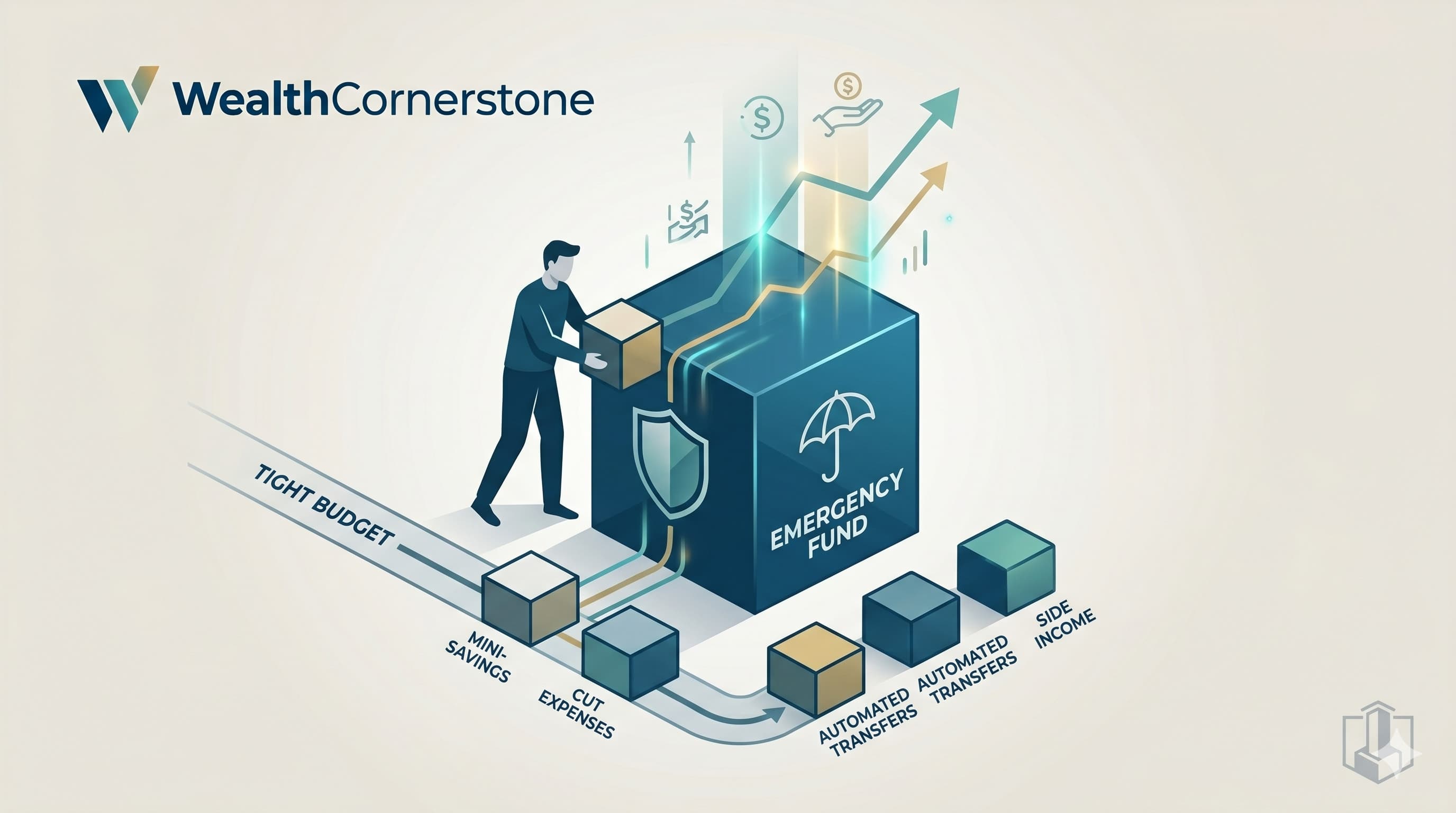
Choosing the right place to store your cash often comes down to a choice between a traditional savings account and a money market account (MMA). At its simplest level, a savings account is a secure place to park money you don't need right away, while a money market account is a hybrid that acts like a savings account but gives you some features of a checking account, such as the ability to write checks or use a debit card. Understanding the nuances of a savings vs money market comparison is essential because picking the wrong one could mean lower interest rates or unexpected fees that eat into your hard-earned capital. Whether you are building an emergency fund or saving for a house, finding the best savings vehicle depends on how often you need to touch your money and how much you have to deposit.
This article is for educational purposes only and does not constitute personalized financial advice. Consult a qualified financial advisor before making significant financial decisions.
The decision between these two options matters because liquid savings are the foundation of any stable financial plan. For many households, the goal is to maximize the interest earned while maintaining easy access to funds. While both accounts generally offer higher interest rates than a standard checking account and provide federal insurance protection, they serve slightly different roles in a modern portfolio. By the end of this guide, you will know exactly which account aligns with your specific financial goals.
The 3-2-1 Liquidity Framework
When deciding where to place your cash, it is helpful to use a mental model called the 3-2-1 Liquidity Framework. This rule helps you categorize your money based on when you will need it, ensuring you never sacrifice growth for access or vice versa. The framework suggests that for every $6,000 you have in cash:
- 3 Parts ($3,000) should be in a high-yield savings account for long-term emergencies (e.g., job loss).
- 2 Parts ($2,000) should be in a money market account for medium-term "lumpy" expenses (e.g., quarterly taxes or car repairs).
- 1 Part ($1,000) should remain in your primary checking account for immediate monthly bills.
Let’s look at a real-world worked example. Consider Marcus, a freelance graphic designer who earns a fluctuating income that averages $5,000 per month. Marcus has managed to save $18,000 in total cash. Following the 3-2-1 Liquidity Framework, Marcus would allocate his funds as follows:
- Savings Account ($9,000): This serves as his "deep" emergency fund. He keeps it in a high-yield savings account (HYSA) at an online bank earning 4.50% APY. He rarely touches this, allowing the interest to compound.
- Money Market Account ($6,000): Because Marcus is a freelancer, he has to pay quarterly estimated taxes. He puts this money in an MMA. When his tax bill comes due, he simply writes a check directly from the account to the IRS. He earns 4.40% APY on this balance, which is far better than the 0.01% he would get in his checking account.
- Checking Account ($3,000): This is his working capital for groceries, rent, and software subscriptions.
By using this framework, Marcus ensures that 83% of his cash is working for him in a high-interest environment, yet he retains the specific transactional flexibility he needs for his business expenses through the money market account.
Key Differences: Comparing Features and Accessibility
While both accounts are designed to hold cash, they have distinct technical characteristics that influence which one is the best savings vehicle for your current situation. The most significant differences lie in how you access your money and the initial requirements to open the account.
A traditional savings account is the "purer" savings tool. It is designed for one-way traffic: money goes in, and it stays there. To get money out, you usually have to transfer it to a linked checking account, which can take one to three business days if the accounts are at different banks. In contrast, a money market account is a "best of both worlds" tool. It offers the high interest of a savings account but includes "checking-like" features.
Feature Comparison Table
| Feature |
Savings Account |
Money Market Account |
| Primary Purpose |
Long-term cash storage |
Flexible savings with limited access |
| Interest Rates |
Generally high (especially online) |
Competitive; often tiered by balance |
| Check Writing |
Not available |
Often included (usually 6 per month) |
| Debit Card |
Rare |
Frequently included |
| Minimum Deposit |
Often $0 to $100 |
Often $500 to $2,500+ |
| Maintenance Fees |
Low or easily waived |
May require higher balances to waive |
| Insurance |
FDIC or NCUA insured |
FDIC or NCUA insured |
To see this in practice, let's look at Elena. Elena is a 29-year-old nurse who recently received a $5,000 inheritance. She is debating between a high-yield savings account and a money market account at her local credit union.
- The Savings Account offers 4.25% APY with a $5 minimum balance.
- The Money Market Account offers 4.35% APY, but only if she maintains a $2,500 balance. If her balance drops below that, she is charged a $15 monthly fee.
If Elena knows she might need to dip into this money frequently for small car repairs, she might prefer the Money Market Account for its debit card access. However, if she is worried about her balance falling below the $2,500 threshold, the savings account is the safer, more cost-effective choice.
Understanding the "Rule of 6"
Historically, both account types were governed by the Federal Reserve's "Regulation D," which limited "convenient" withdrawals to six per month. While the Federal Reserve suspended this requirement in 2020 to provide more flexibility during the pandemic, many banks have kept these limits in place.
- Excessive Withdrawal Fees: Many banks still charge $5 to $15 if you exceed six withdrawals in a month.
- Account Conversion: If you repeatedly exceed the limit, the bank may forcibly convert your money market or savings account into a standard checking account, which usually carries a much lower interest rate.
- Transaction Tracking: It is vital to track your transfers, especially if you have automated "round-up" savings features enabled.
Benchmarks and Balance Thresholds
When evaluating these accounts, you must look at the specific numbers. Interest rates (expressed as Annual Percentage Yield or APY) and minimum balance requirements are the two most important variables.
In a high-rate environment, the difference between a "big bank" savings account and an "online" high-yield savings or money market account can be staggering. Large national banks often offer rates as low as 0.01% or 0.05%. Meanwhile, online-first institutions and competitive credit unions may offer 4.00% to 5.00% or higher.
Consider James, who keeps $25,000 in a "Premier Savings" account at a traditional brick-and-mortar bank earning 0.01%. In one year, James earns just $2.50 in interest. If James moved that same $25,000 to a money market account earning 4.50%, he would earn $1,125 in interest over the same period. That is a difference of over $1,100—money James is essentially "paying" the bank for the convenience of a physical branch he rarely visits.
Use the calculator below to find your number in seconds.
When to Choose a Money Market Account
A money market account is often the superior choice when you have a larger balance and need occasional direct access to the funds. Here are the common benchmarks where an MMA shines:
- The $5,000 Threshold: Most high-tier MMAs require at least $2,500 to $5,000 to unlock the best interest rates.
- The "Lumpy" Bill Scenario: If you have large, infrequent expenses like property taxes, tuition payments, or annual insurance premiums, the ability to write a check directly from the interest-bearing account saves you the step of transferring money to checking first.
When to Choose a Savings Account
A savings account is typically better for smaller balances or specific "sinking funds."
- Automated Savings: If you are saving $100 per month from your paycheck, a savings account with no minimum balance requirement is perfect.
- Psychological Barrier: Because you cannot easily spend money from a savings account via a debit card or check, it creates a "friction" that helps many people avoid impulsive spending.
The "Lazy Cash" Mistake: A $10,000 Error
The single most common mistake readers make when comparing savings and money market accounts is not the choice between the two, but the choice to do nothing at all. This is often referred to as the "Lazy Cash" trap.
Many people leave their entire emergency fund in a standard checking account. They do this because it feels "safe" and "simple." However, the cost of this simplicity is visceral when you look at the long-term dollar impact. Let's simulate a scenario with Sarah, a 35-year-old marketing manager who keeps a constant balance of $30,000 in her checking account "just in case."
The Scenario:
Sarah leaves that $30,000 in her checking account for five years. The checking account pays 0% interest.
- Balance after 5 years: $30,000.
- Total interest earned: $0.
The Alternative:
Sarah moves $25,000 of that money into a money market account earning a conservative average of 4% APY over those five years (keeping $5,000 in checking for bills).
- Year 1 Interest: $1,000
- Year 2 Interest: $1,040
- Year 3 Interest: $1,081
- Year 4 Interest: $1,124
- Year 5 Interest: $1,169
- Total Balance after 5 years: $30,414 (plus her $5k checking)
- Total interest earned: $5,414.
By being "lazy" with her cash, Sarah effectively lost $5,414. That is the cost of a high-end vacation, a significant car repair, or a massive head start on a retirement contribution. When you factor in inflation—which averages around 2% to 3%—Sarah’s $30,000 in the checking account actually lost purchasing power. In five years, her $30,000 might only buy what $26,000 buys today. By using a money market or high-yield savings account, she helps her money keep pace with the rising cost of living.
Another common mistake is failing to check the "fine print" on teaser rates. Some banks offer a very high APY on money market accounts but only for the first three months, or only on the first $10,000. If Robert deposits $50,000 into such an account, he might earn 5% on the first $10k but only 0.50% on the remaining $40k. He would be far better off in a flat-rate savings account paying 4.25% on the entire balance.
Finding Your Best Savings Vehicle
To choose between a savings vs money market account, you must assess your own behavior and the size of your cash pile. If you are just starting out and need a simple, no-fee place to build your first $1,000, a high-yield savings account is almost always the answer. The lack of minimum balance requirements and the mental separation from your spending money make it an ideal "vault."
However, if you have already built a substantial cushion and find yourself frequently transferring money back and forth to cover large bills, the money market account offers a level of sophistication and convenience that is hard to beat. It allows you to consolidate your "secondary" finances into one place without sacrificing the yield that makes your money grow.
Regardless of which you choose, the goal is to ensure your liquid savings are protected by federal insurance. Always verify that your chosen institution is FDIC-insured (for banks) or NCUA-insured (for credit unions). This guarantees that your deposits up to $250,000 per depositor, per institution, are safe even if the bank faces financial trouble.
The single best action you can take today is to look at your primary bank statement. If you are earning less than 4% on your emergency fund, you are leaving money on the table. Move your funds to a high-yield environment—whether that is a savings or money market account—and let compound interest do the heavy lifting for you.
To explore more ways to optimize your cash strategy, visit our savings resource center for deep dives into high-yield strategies and emergency fund planning.
Frequently Asked Questions
Can I lose money in a money market account?
Unlike a money market fund (which is an investment product found in brokerage accounts), a money market account is a bank deposit product. As long as the account is at an FDIC-insured bank or NCUA-insured credit union, your principal is protected up to $250,000. You cannot "lose" your initial deposit due to market fluctuations. The only way your balance would decrease is if the bank charges maintenance fees that exceed the interest you earn, which is why it is crucial to choose an account with no monthly fees or a minimum balance you can easily maintain.
Do money market accounts always have higher rates than savings accounts?
Not necessarily. In the past, money market accounts almost always offered higher yields in exchange for higher minimum deposits. However, with the rise of online-only banks, high-yield savings accounts often offer rates that are just as high, if not higher, than money market accounts. For example, an online bank might offer 4.50% on a savings account with a $0 minimum, while a local credit union offers 4.00% on a money market account with a $2,500 minimum. Always compare the specific APY and the requirements to earn that rate before opening an account.
How many times can I withdraw money from these accounts?
While the federal government suspended the mandatory six-withdrawal limit (Regulation D) in 2020, many financial institutions still enforce their own limits. Most savings and money market accounts allow up to six "convenient" withdrawals per month—this includes online transfers, checks, and debit card transactions. ATM withdrawals and in-person teller transactions often do not count toward this limit, but you should check your bank's specific policy. Exceeding the limit usually results in an "excessive usage fee," which can range from $5 to $15 per transaction.
Is a money market account better for an emergency fund?
A money market account can be excellent for an emergency fund because it provides immediate access to cash via checks or a debit card. If your car breaks down at a repair shop that doesn't accept digital transfers, being able to write a check from your MMA is a major advantage. However, if you find that having a debit card makes it too easy to spend your emergency fund on non-emergencies, a high-yield savings account might be better. The "friction" of having to wait 24 hours for a transfer can act as a helpful guardrail for your financial discipline.
This article is for educational purposes only and does not constitute personalized financial advice. Consult a qualified financial advisor before making significant financial decisions.