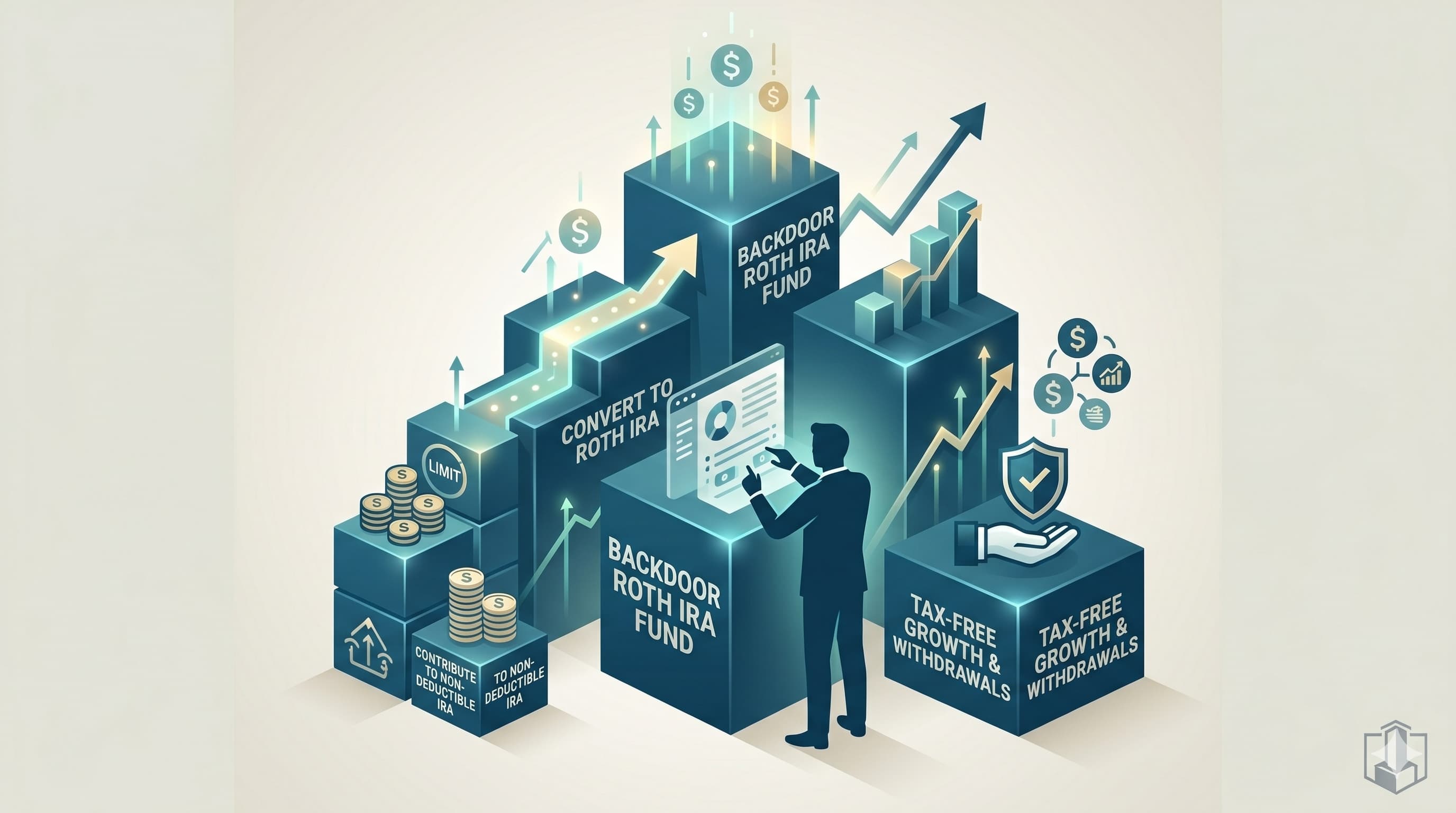
Imagine you have successfully saved $1 million in your 401(k), but you want to retire at age 45. Under normal IRS rules, if you touch that money before age 59½, you will be hit with a 10% early withdrawal penalty on top of the income taxes you already owe. A roth conversion ladder is a strategic financial bridge that allows you to move money from your traditional retirement accounts into a Roth IRA so you can spend it tax-free and penalty-free before you reach the official retirement age. It is the ultimate early retirement tax strategy for those who want to reclaim their time without losing a massive chunk of their wealth to the government.
For most people, the biggest hurdle to early retirement is not the total amount saved, but the accessibility of those funds. By understanding how to "climb" this ladder, you can effectively create a pipeline of tax-free retirement income that starts five years after you begin the process. This strategy is primarily used by members of the FIRE (Financial Independence, Retire Early) community, but it is equally valuable for anyone who plans to stop working before they are eligible for Medicare or Social Security.
The Core Framework: The 5-Year Rule for Conversions
The Roth conversion ladder is built entirely upon a specific IRS regulation known as the "5-year rule" for Roth conversions. Unlike direct contributions to a Roth IRA, which can be withdrawn at any time without tax or penalty, money moved from a Traditional IRA to a Roth IRA via a conversion must "season" for a full five years before the principal (the amount you converted) can be withdrawn penalty-free by someone under age 59½.
To use this framework effectively, you must convert a specific amount of money each year—typically the amount you need to live on five years from now. Each year’s conversion represents one "rung" on the ladder. Because you pay income tax in the year of the conversion, the money is considered "basis" or principal once it has sat in the Roth IRA for five years. After that period, the IRS allows you to withdraw that specific converted amount without the 10% early withdrawal penalty.
A Worked Example: Mark’s Early Retirement
Mark is 40 years old and plans to retire at age 45. He has $800,000 in a Traditional 401(k) and $250,000 in a taxable brokerage account. He needs $50,000 per year to cover his living expenses.
- Age 40-44: Mark continues to work and save.
- Age 45: Mark retires. He rolls his 401(k) into a Traditional IRA. He then converts $50,000 from the Traditional IRA to a Roth IRA. He pays income tax on that $50,000 using his taxable brokerage account. To live this year, he spends $50,000 from his brokerage account.
- Age 46: Mark converts another $50,000. He lives off his brokerage account.
- Age 50: The $50,000 Mark converted at age 45 has now been in the Roth IRA for five years. He can now withdraw that $50,000 penalty-free. He converts another $50,000 this year to be used when he is 55.
By repeating this process, Mark has created a rolling "ladder" where a new $50,000 chunk of money becomes available every single year, tax-free and penalty-free, until he reaches age 59½ and can access his retirement accounts normally.
How to Implement the Roth Conversion Ladder
Implementing this strategy requires a high degree of organization and a clear understanding of your annual cash flow. It is not a "set it and forget it" strategy; it is an annual tax-planning event. The process generally follows these five steps:
- Consolidate to a Traditional IRA: Most people start with money in a 401(k) or 403(b). Since you cannot usually do a Roth conversion ladder inside an active employer plan, you must roll those funds into a Traditional IRA after you leave your job.
- Calculate Your Target Conversion: Determine your annual spending needs. You should also look at the current federal income tax brackets. Often, early retirees try to convert just enough to fill up the 10% or 12% tax brackets to keep their tax bill low.
- Perform the Conversion: Move the funds from the Traditional IRA to the Roth IRA. This is usually a simple "transfer" or "move" request with your brokerage (like Vanguard, Fidelity, or Schwab).
- Pay the Taxes from Outside Funds: This is a critical step. To maximize the ladder, you should pay the income taxes owed on the conversion using cash from a taxable savings or brokerage account. If you withhold taxes from the conversion amount itself, the IRS views that withholding as an early distribution, which may trigger the very 10% penalty you are trying to avoid.
- Track the 5-Year Clock: You must maintain records showing when each conversion occurred. Each annual conversion has its own separate five-year timer.
Managing Tax Brackets: Elena’s Scenario
Elena, 52, is a single filer who just retired. She has $1.2 million in a Traditional IRA. She wants to use a Roth conversion ladder to access $60,000 a year. In 2024, the 12% tax bracket for single filers goes up to $47,150 (after the standard deduction).
If Elena converts $60,000, some of that money will fall into the 22% bracket. To optimize her strategy, she might decide to convert only $50,000 to stay mostly within the 12% bracket and pull the remaining $10,000 from her taxable savings. This tactical "bracket topping" ensures she never pays more than 12% in federal taxes on her future income, whereas she might have been in the 24% or 32% bracket while she was working.
Comparing the Numbers: Roth Ladder vs. Other Strategies
When planning for early retirement, it’s helpful to see how the Roth conversion ladder stacks up against other methods of accessing cash. Many retirees consider simply paying the penalty or using a taxable brokerage account. The following table compares the three most common approaches for a retiree needing $50,000 per year who is currently in the 12% tax bracket.
| Feature |
Roth Conversion Ladder |
Taxable Brokerage Account |
Early Withdrawal (Penalty) |
| Early Access? |
Yes, after 5-year wait |
Yes, immediately |
Yes, immediately |
| Tax Treatment |
Taxed at conversion, then free |
Capital gains tax (0%, 15%, or 20%) |
Income tax + 10% penalty |
| Penalty Risk |
0% if 5-year rule is met |
0% |
10% flat penalty |
| Source of Funds |
Traditional IRA/401(k) |
After-tax savings |
Traditional IRA/401(k) |
| Long-term Growth |
Grows tax-free in Roth |
Grows tax-deferred (but dividends taxed) |
Reduced by taxes/penalties |
As the table demonstrates, the Roth conversion ladder offers a unique middle ground. While a taxable brokerage account is the most flexible, many people reach retirement age with the bulk of their net worth locked in tax-advantaged 401(k) plans. For these individuals, the ladder is significantly more efficient than taking a 10% "haircut" via the early withdrawal penalty.
Use the calculator below to find your number in seconds.
The "Tax-Free" Income Misconception
It is important to clarify what "tax-free" means in the context of a Roth conversion ladder. When you move money from a Traditional IRA to a Roth IRA, the IRS views that as income. You will pay income tax in the year you perform the conversion.
However, the "tax-free" benefit comes later. Once the money is in the Roth IRA and the five-year clock has passed, the principal can be withdrawn without further taxation. Furthermore, all the investment growth that occurs inside the Roth IRA after the conversion becomes tax-free once you reach age 59½.
For an early retiree, this is a massive advantage. If you convert $50,000 at age 45 and it grows to $150,000 by the time you are 60, you have effectively shielded $100,000 of growth from ever being taxed again. This is why many financial experts refer to the Roth IRA as the most powerful tax-savings tool in the U.S. tax code.
The Visceral Cost of the Pro-Rata Mistake
The most devastating mistake a reader can make when attempting a Roth conversion strategy is ignoring the IRS Pro-Rata Rule. This rule applies if you have "after-tax" money in any of your Traditional IRAs. Many people believe they can just convert the "after-tax" portion (to avoid taxes) and leave the "pre-tax" portion alone. The IRS does not allow this; they view all your Traditional, SEP, and SIMPLE IRAs as one giant bucket.
The $18,000 Error: James’s Story
James is 48 and wants to start his ladder. He has $200,000 in a Traditional IRA (all pre-tax) and $50,000 in a Rollover IRA from an old job. He also has a small $10,000 "non-deductible" IRA he opened years ago. James thinks he can just convert that $10,000 non-deductible portion to his Roth IRA and pay $0 in taxes because he already paid taxes on that $10,000.
However, because of the Pro-Rata rule, the IRS looks at his total IRA balance of $260,000. Only 3.8% ($10k / $260k) of his total IRA money is after-tax. When he converts $10,000, the IRS considers only $380 of it to be tax-free. The other $9,620 is treated as taxable income.
If James was counting on that conversion being tax-free and didn't set aside money for the bill, he might find himself in a higher tax bracket than expected. Even worse, if James makes a mistake and tries to pull money out of his Roth IRA before the five-year clock is up, or if he pays the conversion tax using the IRA funds, he could trigger the 10% penalty.
If James converted $100,000 and used $24,000 of that money to pay the IRS, that $24,000 is considered an early distribution. At a 10% penalty, he just lit $2,400 on fire for no reason, plus he lost the opportunity for that $24,000 to grow tax-free for the next decade. Over 10 years at a 7% return, that mistake costs him over $47,000 in future wealth.
Advanced Considerations: ACA Subsidies and State Taxes
While the federal tax implications are the primary focus of a Roth conversion ladder, savvy retirees must also consider two "hidden" factors: health insurance subsidies and state-level taxation.
- ACA Subsidies: Under the Affordable Care Act (ACA), your health insurance premiums are subsidized based on your Modified Adjusted Gross Income (MAGI). Because a Roth conversion counts as income, a large conversion could push your MAGI high enough to reduce or eliminate your health insurance subsidies. For a family of four, this could mean an extra $1,000 to $2,000 per month in health insurance costs—effectively a "hidden tax" on your conversion.
- State Taxes: Not all states treat Roth conversions the same way. Most states follow federal lead and tax the conversion as income, but some states have specific exclusions for retirement income or different tax brackets. If you live in a high-tax state like California or New York, you may want to wait until you move to a tax-friendly state like Florida or Texas to begin your ladder.
Strategic Priority Checklist
- Check your "Bridge Fund": Ensure you have at least 5 years of living expenses in a taxable brokerage account or cash before you start the ladder.
- Clean up your IRAs: If you have multiple Traditional, SEP, or SIMPLE IRAs, consider rolling them into a current 401(k) if your employer allows it to "isolate" your basis and avoid the Pro-Rata rule.
- Project your MAGI: Calculate how your conversion will impact your eligibility for the Premium Tax Credit (ACA subsidy).
- Automate your record-keeping: Create a spreadsheet tracking the year of conversion, the amount converted, and the date it becomes "penalty-free."
By following these steps, you transform the Roth conversion ladder from a complex tax theory into a practical, repeatable engine for financial freedom. The key is starting early—ideally five years before you actually need the first dollar.
To learn more about optimizing your retirement withdrawals and minimizing what you owe the IRS, explore our comprehensive guide to managing your taxes in retirement.
This article is for educational purposes only and does not constitute personalized financial advice. Consult a qualified financial advisor before making significant financial decisions.
Frequently Asked Questions
Can I still use a Roth conversion ladder if I am over 59½?
While you can certainly perform Roth conversions after age 59½, the "ladder" aspect becomes less critical because the 10% early withdrawal penalty no longer applies to you. At this age, you can withdraw from Traditional IRAs and 401(k)s without penalty, though you still owe income tax. However, conversions are still a popular strategy for seniors who want to reduce their future Required Minimum Distributions (RMDs) or leave a tax-free inheritance to their heirs. The 5-year rule for withdrawals of earnings still applies, but for the most part, the "ladder" is a tool specifically designed for the early retirement community.
What happens if I withdraw the money before the 5 years are up?
If you withdraw converted funds from your Roth IRA before the 5-year "seasoning" period is complete, the IRS will generally impose a 10% early withdrawal penalty on the amount withdrawn if you are under age 59½. This effectively negates the primary benefit of the ladder. It is also important to note that the IRS has a specific "ordering rule" for Roth withdrawals: contributions come out first (always tax/penalty-free), then conversions (subject to the 5-year rule), and finally earnings (subject to tax and penalty before 59½). You must be careful not to dip into the conversion "rung" until its specific 5-year clock has expired.
Does the 5-year rule reset every time I make a new conversion?
Yes and no. For the purpose of the Roth conversion ladder and avoiding the 10% penalty on the principal, each conversion has its own separate 5-year clock. For example, a conversion made in 2024 becomes penalty-free on January 1, 2029. A conversion made in 2025 becomes penalty-free on January 1, 2030. This is why it is called a "ladder"—you are building a series of maturing "rungs." However, there is a separate 5-year rule for withdrawing earnings (the growth) tax-free, which starts with the very first Roth IRA you ever opened and funded. Understanding the difference between these two rules is essential for avoiding unexpected taxes.