How to Rebalance Your Investment Portfolio
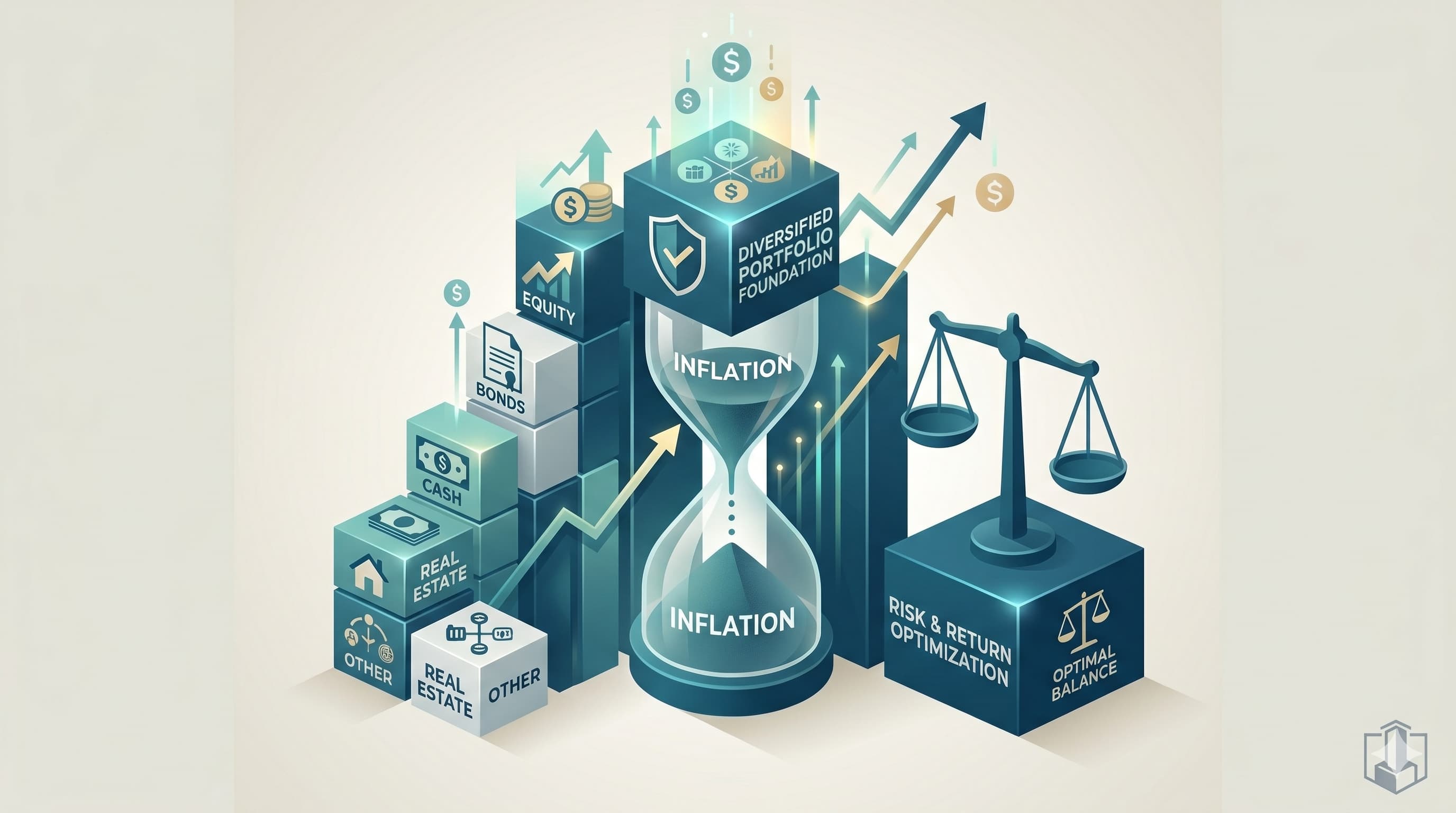
Portfolio rebalancing is the process of adjusting the weightings of your assets within your investment portfolio to maintain your original, desired level of risk. Imagine you decided to build a garden with 50% roses and 50% lilies, but over time the roses grew much faster and took over 80% of the space; rebalancing is simply the act of pruning the roses and planting more lilies to bring the garden back to its original balance. This investment maintenance ensures that your portfolio does not become accidentally too risky or too conservative because of market movements. Whether you are a seasoned investor or just starting, understanding how to perform an asset allocation reset is a foundational skill for long-term financial health.
This article is for educational purposes only and does not constitute personalized financial advice. Consult a qualified financial advisor before making significant financial decisions.
The 5/25 Rule: A Framework for Portfolio Rebalancing
To master your investment strategy, you need a rule that tells you exactly when to act. In the world of financial planning, one of the most effective mental models is the "5/25 Rule." This framework provides clear thresholds for when your portfolio has drifted too far from its target and requires an asset allocation reset.
The rule states that you should rebalance your portfolio when an asset class deviates by either an absolute 5% or a relative 25% from its target allocation. This prevents you from over-trading (which creates unnecessary tax hits and fees) while ensuring your risk profile doesn't slide out of control.
Consider the example of Marcus, a 40-year-old investor with a target allocation of 60% Stocks and 40% Bonds in a $200,000 portfolio.
- Target: $120,000 Stocks (60%) / $80,000 Bonds (40%)
- The Market Move: After a massive stock market rally, Marcus’s stocks grow to $150,000, while his bonds remain at $80,000.
- New Total: $230,000
- Current Allocation: 65.2% Stocks / 34.8% Bonds
In this scenario, Marcus’s stock allocation has drifted by 5.2% in absolute terms (from 60% to 65.2%). According to the 5/25 Rule, Marcus has hit the threshold for action. If he does nothing, he is now carrying significantly more risk than he originally intended. If the stock market were to crash the following week, he would lose more money than his original 60/40 plan accounted for. To rebalance, Marcus would sell $12,000 worth of stocks and use the proceeds to buy $12,000 worth of bonds, returning his portfolio to the 60/40 split.
Choosing Your Rebalancing Strategy
There is no "one size fits all" approach to investment maintenance. Most investors choose between a time-based approach or a threshold-based approach. Each has pros and cons regarding effort and efficiency.
Time-Based Rebalancing (The Calendar Method)
This involves checking your portfolio at set intervals—usually semi-annually or annually. On a specific date, such as your birthday or the first of the year, you look at your percentages and adjust them. The benefit is simplicity; the downside is that a major market swing could happen in February, and if you don't check until December, you may have been exposed to high risk for ten months.
Threshold-Based Rebalancing (The Percentage Method)
This is the application of the 5/25 rule mentioned above. You only rebalance when your assets move away from their targets by a specific percentage. This is more efficient because it responds to market reality rather than a random date on the calendar. However, it requires more frequent monitoring of your account.
| Rebalancing Method |
Frequency of Action |
Pros |
Cons |
| Calendar-Based |
Fixed (e.g., Annual) |
Low effort, predictable schedule. |
May ignore major market volatility. |
| Threshold-Based |
Variable (as needed) |
High precision, better risk control. |
Requires more frequent monitoring. |
| Cash Flow Rebalancing |
Ongoing |
Minimizes taxes and commissions. |
Only works if you are actively contributing. |
| Hybrid Approach |
Quarterly Review |
Balanced and realistic for most. |
Can still lead to "drift" between reviews. |
The Math of the Reset: Identifying Your Numbers
Before you can execute a rebalance, you must identify your "Target Allocation." This is the percentage of your money that should be in stocks, bonds, real estate, or cash based on your age, goals, and risk tolerance. For a typical mid-career professional, this might be a 70/30 split. For someone nearing retirement, it might be 50/50.
To calculate your rebalancing needs, follow these steps:
- Determine Current Value: Add up the total value of all accounts (401k, IRA, Brokerage).
- Apply Target Percentages: Multiply the total value by your target (e.g., Total * 0.70 for stocks).
- Identify the Gap: Subtract your target value from your current value.
- Execute: Buy or sell to bridge that gap.
Use the calculator below to find your number in seconds.
Tax-Efficient Execution
Performing an asset allocation reset in a taxable brokerage account is different than doing so in a tax-advantaged account like a 401(k) or a Roth IRA. In a 401(k), you can sell winners and buy losers without triggering any immediate tax bill. However, in a standard brokerage account, selling a stock that has gone up in value triggers a "capital gains tax."
If you have held the asset for more than a year, you will likely pay long-term capital gains tax (usually 15% or 20% depending on your income). If you have held it for less than a year, you pay your ordinary income tax rate, which is significantly higher.
To remain tax-efficient, consider these strategies:
- Rebalance with new money: Instead of selling your winners, simply direct your new monthly contributions into the assets that are currently underweight. This allows you to rebalance without selling anything or triggering taxes.
- Sell in tax-advantaged accounts first: If you have the same assets in both a Roth IRA and a taxable account, do all your "selling" in the Roth IRA to avoid the IRS.
- Tax-Loss Harvesting: If some of your investments have lost money, you can sell them to "offset" the gains from the winners you are selling to rebalance.
The "Winning Streak" Trap: A Mistake Simulation
The most common mistake investors make is a psychological one: they fall in love with their winners. This is known as "recency bias." When a specific sector, like technology stocks, has a phenomenal year, investors feel an emotional resistance to selling those stocks. They want to "let it ride."
Let's look at a simulation of why this is dangerous.
The Scenario:
Sarah has a $500,000 portfolio. Her target is 50% Stocks and 50% Bonds.
In Year 1, the stock market explodes, returning 30%. Her bonds return 0%.
Her portfolio is now:
- Stocks: $325,000 (65%)
- Bonds: $250,000 (35%)
- Total: $575,000
Sarah decides NOT to rebalance. She tells herself, "Stocks are doing great; why would I sell them to buy boring bonds?"
In Year 2, the stock market enters a "bear market" and drops by 40%.
Because Sarah didn't rebalance, her $325,000 in stocks crashes to $195,000. Her total portfolio is now $445,000. She has lost $130,000.
The Rebalanced Alternative:
If Sarah had rebalanced at the end of Year 1, she would have sold $37,500 of stocks to buy bonds, bringing her back to a 50/50 split ($287,500 in each).
When the Year 2 crash happened, her $287,500 in stocks would have dropped to $172,500. Her bonds would have stayed at $287,500.
Her total portfolio would be $460,000.
By failing to rebalance, Sarah lost an extra $15,000. More importantly, because her portfolio was 65% stocks instead of 50%, the emotional pain of the crash was much higher, making her more likely to panic and sell everything at the bottom. Rebalancing is a "buy low, sell high" machine that works automatically if you have the discipline to follow it.
Step-by-Step Guide to Your First Rebalance
Ready to take action? Follow this ordered process to ensure you maintain your investment maintenance without making common errors.
- Log into all accounts: You must look at your "household" portfolio as one giant pie, even if it is spread across different banks or employers.
- Create a spreadsheet: List each asset class (Large Cap, Small Cap, International, Bonds, Cash) and their current dollar values.
- Compare to targets: Check if any asset class has drifted more than 5% from your target.
- Check for new dividends: See if you have uninvested cash or dividends sitting in your accounts. Use this cash first to buy underweight assets.
- Evaluate tax consequences: If you must sell, check if the assets have been held for more than a year to qualify for lower tax rates.
- Place the trades: Sell the over-performing assets and immediately buy the under-performing ones. Do not wait for a "better time" to buy; the goal is to reset the allocation, not to time the market.
- Automate for the future: Many modern brokerage platforms offer "automatic rebalancing" features. If yours does, consider turning it on to remove the emotional burden from your future self.
Effective portfolio management is not about picking the next hot stock; it is about the disciplined management of risk. By regularly performing an asset allocation reset, you ensure that you are buying assets when they are "on sale" and selling them when they are expensive. This counter-intuitive behavior is exactly what builds wealth over decades.
To learn more about building a robust financial foundation, visit our primary guide on how to start investing to see how rebalancing fits into your broader financial plan.
Frequently Asked Questions
How often should I rebalance my portfolio?
For most individual investors, rebalancing once or twice a year is more than enough. Research by firms like Vanguard has shown that there is a diminishing return to rebalancing more frequently (like monthly), as the transaction costs and potential tax implications start to outweigh the risk-reduction benefits. A semi-annual check allows you to capture major market shifts while keeping your workload low. If you prefer a "set it and forget it" approach, an annual rebalance on a memorable date—like your wedding anniversary or New Year's Day—is a highly effective habit.
Should I rebalance if the market is crashing?
Yes, though it is psychologically difficult. If the stock market drops 20%, your stock allocation will likely fall well below your target percentage. Rebalancing during a crash requires you to sell "safe" bonds to buy "risky" stocks. While this feels scary, it is the literal definition of "buying low." By resetting your allocation during a downturn, you position yourself to capture the full gains of the eventual market recovery. However, ensure you have an adequate emergency fund in cash so you aren't forced to sell assets during the dip for living expenses.
Is rebalancing only for people with a lot of money?
Rebalancing is essential for every investor, regardless of account size. While a 5% drift on a $1,000 account is only $50, the habit of rebalancing is what matters. Practicing these steps with small amounts of money prepares you for the day when your portfolio is worth $100,000 or $1,000,000, where a 5% drift could represent $50,000 of unintended risk. Many robo-advisors and target-date funds perform this task automatically for investors with small balances, making it easier than ever to maintain a balanced portfolio from day one.
Does rebalancing increase my total investment returns?
The primary goal of rebalancing is to manage risk, not necessarily to maximize returns. In a prolonged bull market where stocks go up for years without a major correction, a "buy and hold" investor who never rebalances might actually end up with more money because they never sold their winning stocks. However, that investor is also taking on massive amounts of risk. Rebalancing ensures that when the market eventually turns—as it always does—you aren't wiped out by having too much exposure to a single asset class. It provides a "smoother ride" and prevents catastrophic losses.